
In the Regency Era, a person’s ability to converse revealed character and breeding. Knowing how and when to speak—and how to listen—opened doors, secured friendships, began courtships, and protected reputations.
Parents, governesses, and tutors taught the rules governing conversation and social behavior. How or if people followed those rules marked their character.
Let’s take a closer look at how Regency etiquette shaped introductions, everyday conversation, and social interactions.
Conversation Skills Critical in Regency Society
To understand why Regency etiquette placed such importance on conversation, it helps to remember that historical social interactions comprised almost entirely of face-to-face communication. Regency ladies and gentlemen relied on conversation to:
- Demonstrate education and refinement
- Reveal one’s social standing
- Illustrate character and suitability (especially in courtship)
- Allow them to navigate rigid class structures without open conflict.
During the Regency, well-bred ladies balanced engagement with reserve. Gentlemen of character paid attention without intruding or growing too familiar. Yet no amount of charm or wit mattered unless one followed the most fundamental rule of Regency etiquette: a proper introduction.
 Introductions: The Gateway to Polite Interaction
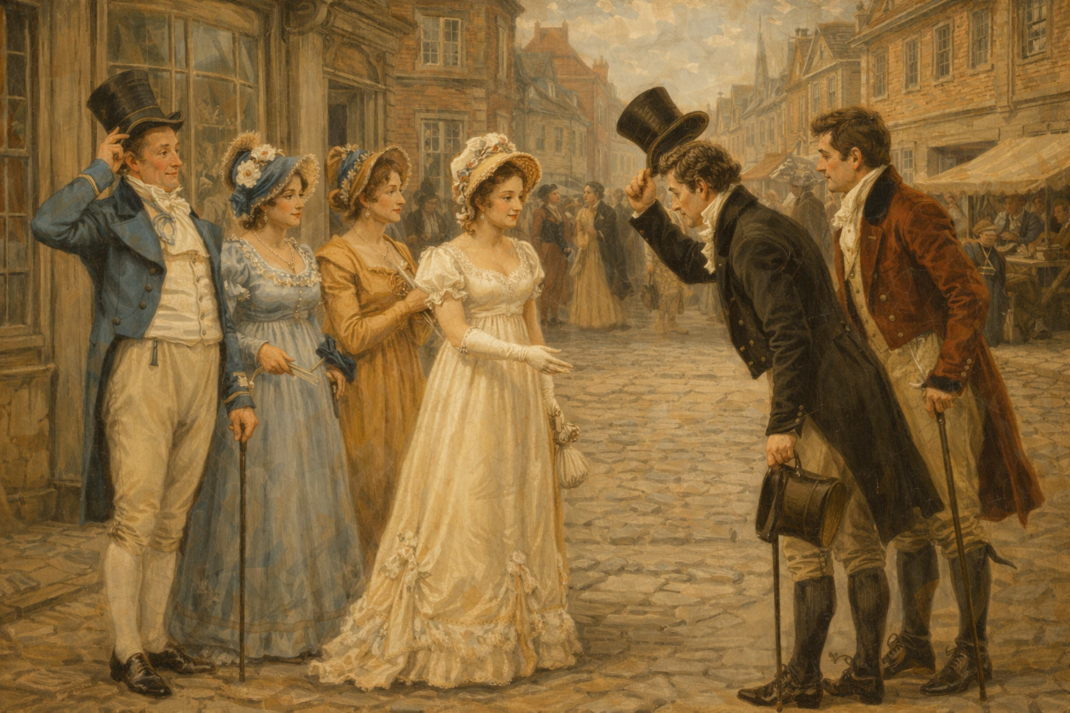
Introductions formed the foundation of proper Regency etiquette and social conduct. Ladies and gentlemen of good breeding never began a conversation without a proper introduction.
Key Rules of Introduction
- A lady and a gentleman waited for a proper introduction before conversing
- A mutual acquaintance, preferably of equal or higher social standing, made the introductions
- A gentleman was introduced to a lady, not the other way around—even if the gentleman out ranked the lady
- Younger people were introduced to older people
- Married women were introduced before unmarried ladies
Jane Austen illustrates this rule perfectly in Northanger Abbey (1817), using a brief but telling moment at a Bath assembly to show how introductions governed every polite interaction. Catherine Morland and her chaperones, the Allens, go to a ball in Bath where they do not know anyone. At first, Catherine is in the socially awkward position of having no acquaintance in the room, and therefore, no one with whom she might converse or dance.
A stranger, Henry Tilney, initially speaks briefly with Mrs. Allen and Catherine. Aware that continued conversation and dancing required an introduction, Mr. Tilney immediately withdraws. He returns with the Master of Ceremonies who introduces to him to Mrs. Allen and Catherine. Once the Master of Ceremonies introduces them, polite conversation becomes possible, and Mr. Tilney is now free to ask Catherine to dance.
(In case you’re wondering, the Master of the Ceremonies was an officially appointed gentleman who ensured that public balls and assemblies ran smoothly and according to social rules. He was usually a well-connected local gentleman, chosen by the assembly committee or subscription holders, and known for impeccable manners and social judgment.)
This scene reveals several key Regency social rules and norms:
- A very brief, polite address to a lady (especially via her chaperone) might occur first in unusual circumstances
- His manner is polite and restrained
- As a gentleman of good breeding, he immediately recognizes the limits
- He secures a proper introduction before attempting further interaction
Henry Tilney’s behavior marks him as socially intelligent, respectful of rules, and most importantly, considerate of a young lady’s reputation — a true gentleman.
Once properly introduced, ladies and gentlemen could converse — but even then, Regency etiquette placed clear limits on what they might say and how it they should expressed it.
 The Art of Polite Conversation
Regency society prized moderation, civility, wit, and discretion in conversation. Good conversationalists never dominated discussion, but contributed gracefully.
Acceptable Topics in Regency Conversation
Anything benign such as:
- The weather
- The size of the gathering, party, ball
- Books, poetry, music, and the arts
- Travel and scenery
- General family news
- Fashion (with restraint)
Topics Best Avoided
Nothing controversial or too personal, like:
- Politics and reform
- Money, debts, or income
- Illness or personal suffering
- Scandal, especially when naming names
- Strong opinions expressed too openly
Austen offers another illuminating example in Pride and Prejudice (1813), where conversation itself becomes a subtle social performance during a dance between Elizabeth Bennet and Mr. Darcy at the Netherfield ball:
“It is your turn to say something now, Mr. Darcy. I talked about the dance, and you ought to make some sort of remark on the size of the room, or the number of couples.”
“Do you talk by rule, then, while you are dancing?”
“Sometimes. One must speak a little, you know. It would look odd to be entirely silent for half an hour together; and yet for the advantage of some, conversation ought to be so arranged as that they may have the trouble of saying as little as possible.”
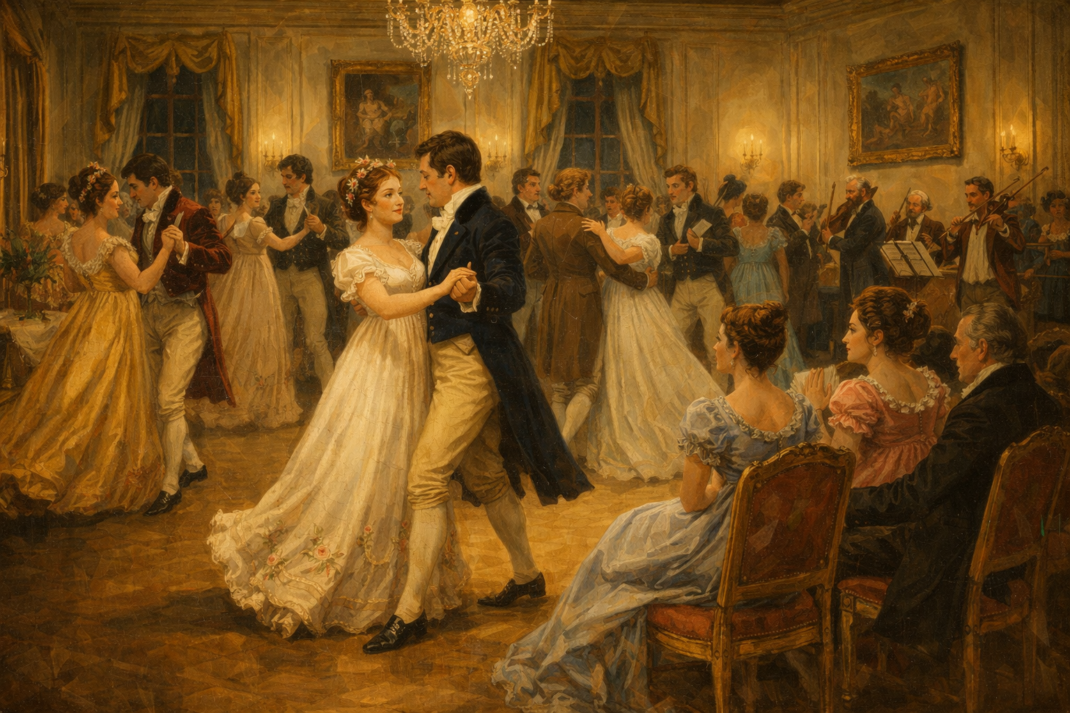
This brief exchange neatly illustrates several key Regency social norms:
1. Polite Society Expected Conversation During a Dance
Elizabeth’s comment — “One must speak a little” — reflects the expectation that complete silence between partners would be socially awkward, even improper. Polite society viewed dancing as both a physical activity and a test of sociability.
2. Conversation Should Remain within Safe Topics
Elizabeth jokingly suggests topics like the dance, the size of the room, and the number of couples. These are all neutral subjects, exactly the sort recommended by period etiquette guides.
3. Wit Was Appreciated — Within the Bounds of Propriety
Elizabeth pushes at the rules by teasing Darcy, but she does so cleverly rather than boldly. People of that era admired wit when paired with self-command. Even while flirting intellectually, both characters remain respectful, controlled, and appropriate. Wit, though prized, had its limits. Regency people admired cleverness but not rudeness.
Also, Elizabeth’s line about arranging conversation so that “some may have the trouble of saying as little as possible” lightly pokes fun at the stiffness of polite society, as well as a subtle mockery of those who are unskilled at conversation—while still behaving as a lady of quality.
Just as important as knowing how to speak was knowing when to remain silent — a skill Regency society prized just as highly.
Listening: The Most Underrated Social Skill
Truly accomplished conversationalists were also excellent listeners. Attentive listening signaled respect, patience, and good breeding. Good manners required people to:
- Allow others to finish speaking
- Respond thoughtfully rather than interrupting
- Avoid self-centered anecdotes
- Encourage quieter guests to participate
Austen highlights the importance of listening by giving readers a deliberate counterexample of Regency social manners in John Thorpe:
“He talked in a loud, rapid way, jumping from subject to subject, with little regard to her situation or feelings, and was continually boasting of his own exploits.”
And:
“He was a great talker, and, from the very first, talked more than any one else present.”
Short, sharp, and devastating — Austen at her finest.
This passage comes during one of John Thorpe’s early interactions with Catherine, when he assumes familiarity, dominates the conversation, and shows no concern for social restraint or her comfort. By violating etiquette despite knowing the rules, Thorpe reveals his coarseness.
A well-bred gentleman waited to be invited into conversation, spoke with measured politeness, and avoided assuming a level of intimacy not yet earned. He refrained from using a person’s name until a genuine acquaintance had been established.
Regency etiquette also regulated where and how conversation occurred, particularly between unmarried men and women.
 Conversation Between Ladies and Gentlemen
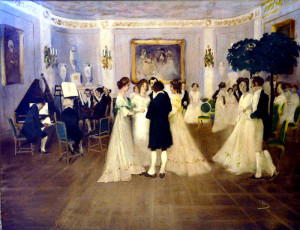
Group conversation helped maintain propriety, particularly in social settings like balls or assemblies. Prolonged private conversation invited others to speculate about a couple’s relationship. Touching, whispering, or standing too closely carried negative social consequences and even scandal.
In Sense and Sensibility (1811) Chapter 15, Elinor directly confronts this issue when she cautions her younger sister Marianne about her transparent affection for Willoughby. Elinor points out that their constant exclusive conversations and Marianne’s undisguised preference have become the subject of general observation. Marianne’s response reveals her naivete:
“I do not attempt to deny,” said she, “that I think very highly of him—that I greatly esteem, that I like him.”
“This is admiration of a very particular kind,” said Elinor, “and as a sensible woman, you must be aware that such conduct must raise the expectations of every body who sees you.”
Elinor warns that such behavior suggests an “understanding” exists between them—and without a formal engagement, this speculation could seriously damage Marianne’s reputation.
Social Missteps and Quiet Judgments
The consequences could ruin people socially when they ignored conversational rules such as:
- Addressing someone without proper introduction
- Speaking excessively or too freely or too emotionally
- Laughing too loudly or drawing attention to oneself
- Publicly contradicting or embarrassing another
- Displaying excessive familiarity
Small mistakes might be overlooked, but repeated offenses were not. In Jane Austen’s Emma (1815), Mrs. Elton provides a masterclass in how not to behave in polite society. Despite considering herself the epitome of elegance, she commits nearly every social offense in the book. For example:
- She name-drops her sister’s estate, Maple Grove, as though others should be impressed.
- She refers to her husband as “my caro sposo” to show off her language skills even though she uses the term incorrectly.
- She addresses Mr. Knightly as simply Knightly, which is considered overly familiar.
- She presumes to call Jane Fairfax simply “Jane” instead of Miss Fairfax—a shocking familiarity for someone she barely knows.
- Most egregiously, she is patronizing to Jane Fairfax by making public offers of assistance to her, treating her like a charity case rather than a gentlewoman.
Mrs. clearly believes herself superior in breeding and manners—yet her violations mark her as vulgar to everyone else in Highbury. Austen uses her to show that knowing the forms of etiquette meant nothing without the discretion and consideration that should underpin them.
 What Historical Etiquette Teaches Us Today
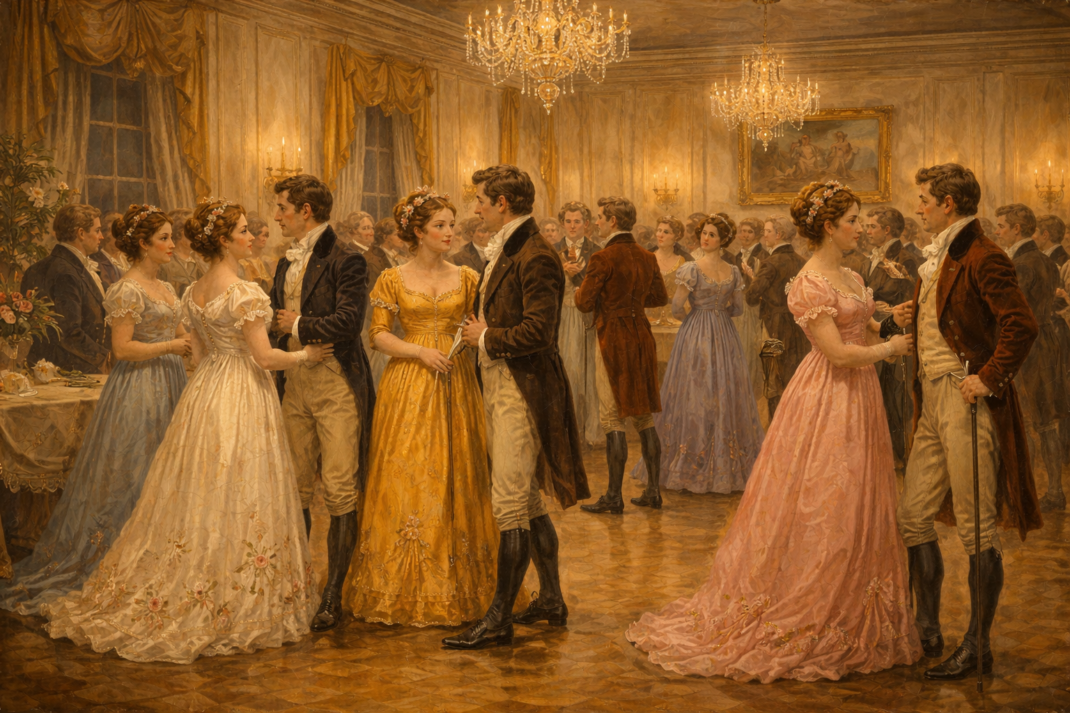
While modern conversation values openness and individuality, 19th century manners emphasized:
- Self-control
- Courtesy
- Consideration for others
- Awareness of social context
- Subtle wit
When we understand these rules of Regency etiquette and conversation, we deepen our appreciation of Regency novels — and the complex social world they depict.
These historical conversation rules also remind us that respectful communication never goes out of style. Whether navigating a Regency ballroom or a modern work party, which of these rules do you think still apply today?

Great article! I can’t help but notice that some of these protocols lasted through the 1910s.