
Discover what it was really like to attend a Regency ball, from dressing for the evening and making your entrance, to country dances, supper, and the delicate rituals of courtship.
Imagine Receiving an Invitation to a Regency ball
Imagine that an invitation to a ball arrives at your door.
Perhaps it is a private ball given by a fashionable family which may be smaller and more select than dancing at a public assembly. Either way, tonight promises an evening of music, friendship, dancing, conversation, and, if you’re unmarried, perhaps the seed of a romance. For a young lady, dancing offers a respectable opportunity to spend time with a gentleman.
However, attending a Regency ball involves more than putting on an attractive gown and arriving. Your reputation matters. Therefore, with whom you arrive, who introduces you, who your dance partners are, and how many dances you accept from the same gentleman will likely attract notice and show your character.
 Preparing for a Regency Ball
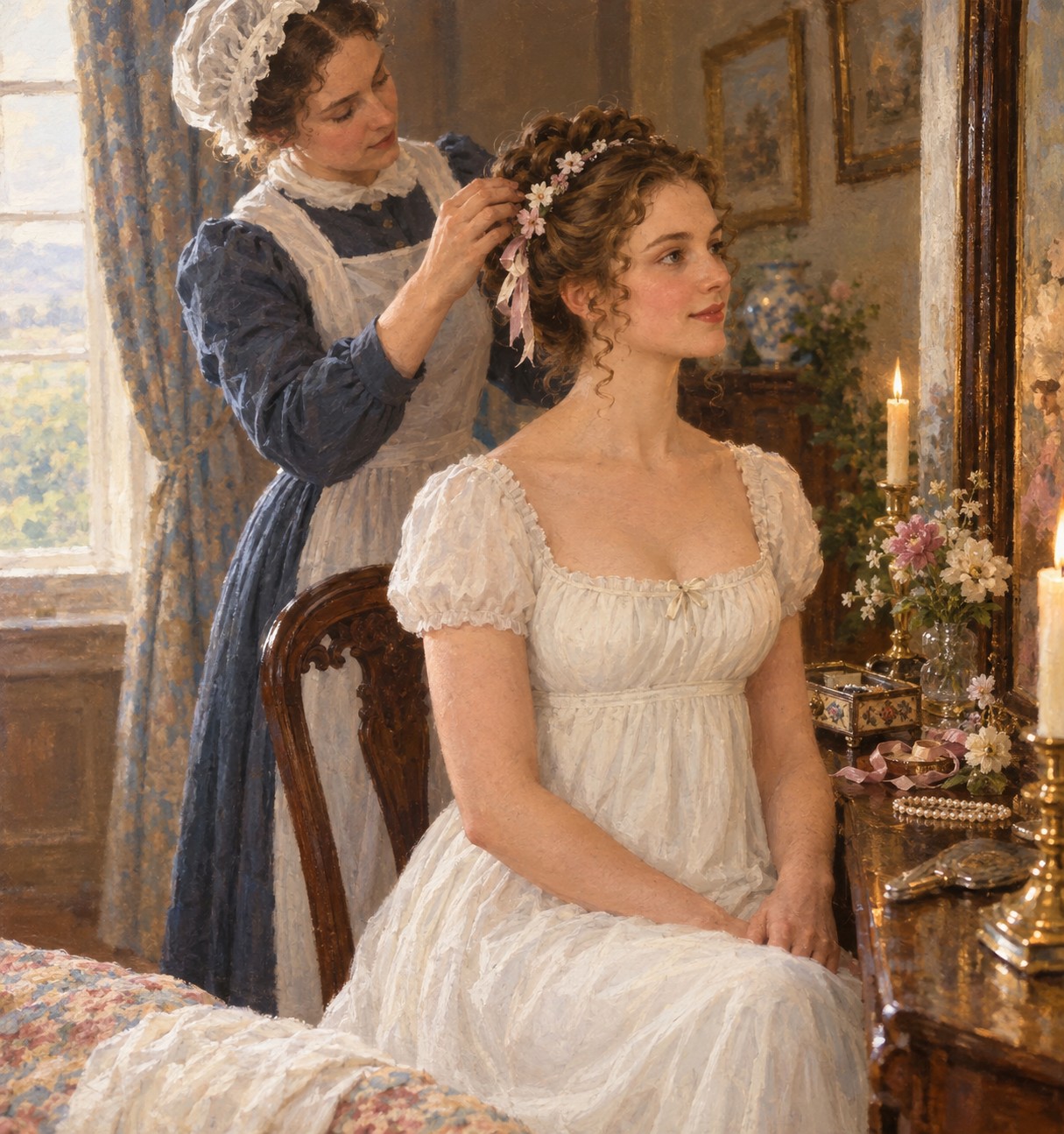
Hours before the ball begins, your maid helps you prepare. You begin with a clean Regency shift, stays, stockings, and petticoat. These undergarments help create the graceful silhouette so characteristic of Regency fashion. While you sit at your dressing table, your maid arranges your hair on top of your head in the latest style, with curls framing your face and perhaps ribbons, pearls, or flowers woven among the curls.
Once your coiffure is complete, you don an elegant silk evening gown with a high waistline of white or pastel colors, as is fashionable. The full skirt and hemline falling just below your ankles allow freedom of movement and reduces the chances of tripping over your skirt. Your jewelry is elegant but restrained. One must never appear ostentatious.
You step into your dancing slippers and pull on long, soft kid leather gloves. You also bring a fan, reticule, and perhaps a shawl as the evening may be cool. Your maid makes the final adjustments to your gown before you descend to await your carriage.
If you are a young unmarried lady, you won’t simply set off alone. A respectable chaperone accompanies you, ensuring that your evening remains both enjoyable and proper.
Arriving at the Regency Ballroom
Your carriage draws up to the home of the host and hostess where a steady stream of fashionable visitors arrive.
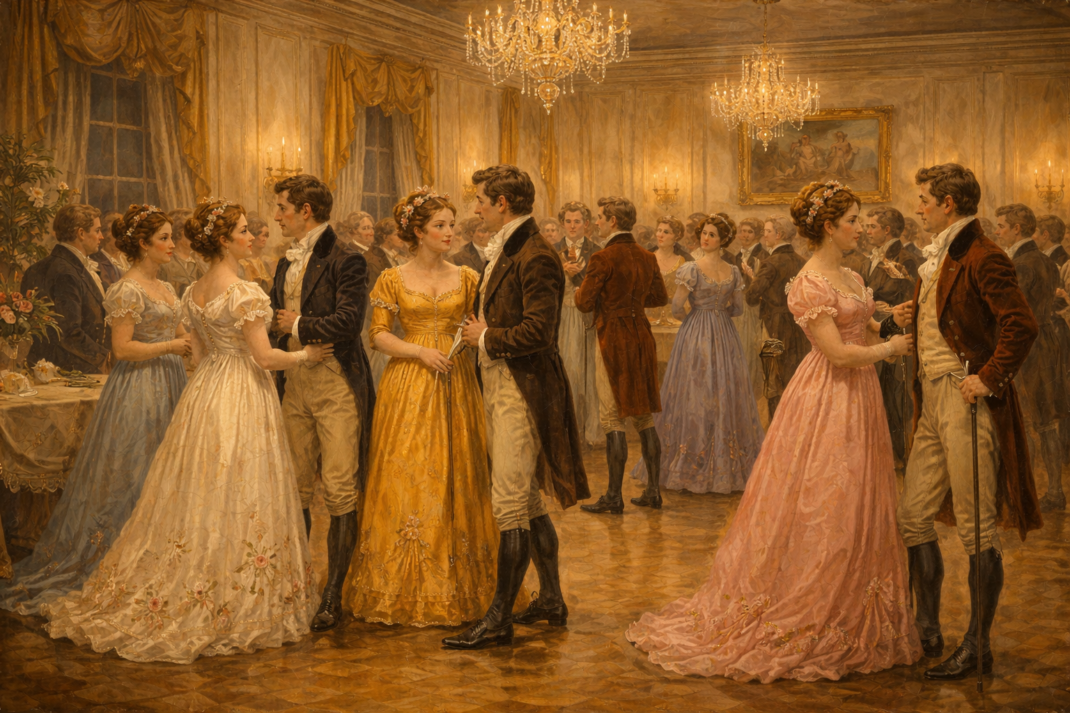
Inside, the ballroom glows with candlelight. The polished floor gleams beneath the chandeliers, musicians prepare their instruments, and ladies in pastel gowns mingle with gentlemen in evening attire. The room hums with conversation as acquaintances greet one another and guests linger at the perimeter of the dance floor.
You pause for a moment to take it all in and notice that everyone is watching everyone else. A Regency ball is entertainment, certainly—but it is also a social stage. Who has arrived? Who is dancing with whom? Which families are present? Which young ladies have attracted the attention of eligible gentlemen?
Nothing escapes notice for long.
Before the Dancing Begins
You greet several friends and acquaintances in the room. You also see new people who you wish to meet. Yet one cannot simply walk up to a stranger and begin chatting. One must be properly introduced before beginning a conversation. A gentleman who wishes to dance with an unfamiliar young lady also needs someone to introduce him. A mutual acquaintance 9or the master of ceremonies at a public assembly0 may perform the introductions.
It is a small moment, but it reveals the importance of social conventions in Regency events. Gentleman with whom you are acquainted, or recently introduced, ask you for dances scheduled for the evening. You and your partners must remember which dances are reserved for dance cards have not yet been widely used.
 Regency Dancing and Courtship
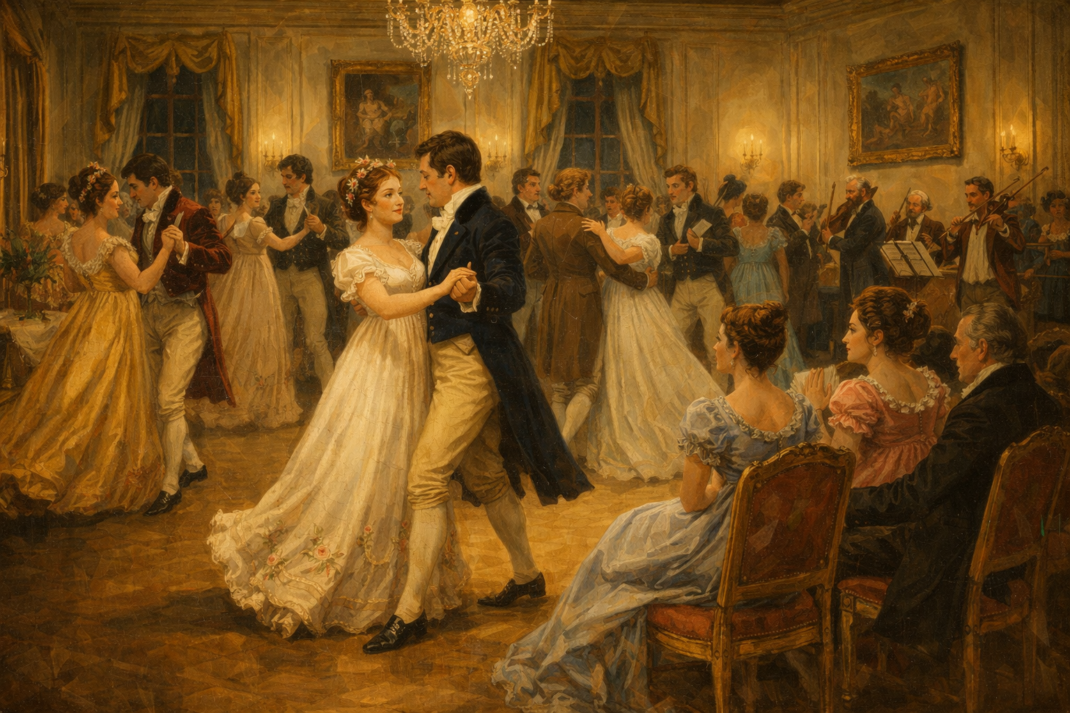
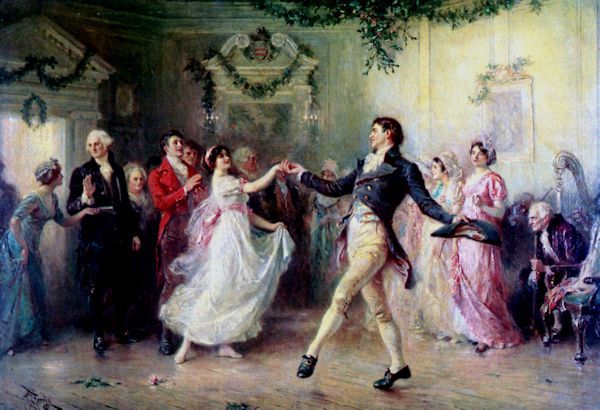
The musicians strike up the opening notes. Your partner arrives for your agreed upon dance. Perhaps you’ve met him before. Perhaps tonight is your first introduction. He leads you to the dance floor.
Unlike a modern dance, a Regency country dance isn’t simply a matter of two people dancing together. Several couples form a set, moving through an established pattern of figures. You must know the steps, pay attention, and make appropriate conversation. Dancing well demonstrates grace, poise, and social accomplishment.
You exchange the customary polite conversation as you move through the figures. The dance gives you an opportunity to observe one another. Is he attentive? Courteous? A good dancer? Does he monopolize your conversation, or does he allow you to speak? Does he behave respectfully toward your chaperone and your friends? And, perhaps most importantly, does he ask you to dance again?
In a society where courtship follows so many rules, a ballroom is a place where romantic interest is communicated through seemingly small gestures.
 Conversation Between the Dances
When the dance ends, you return to your chaperone. There is time for conversation before the next set begins. Perhaps you discuss the music, compliment another lady’s gown, compare lates books you’ve read, or exchange observations about the evening’s guests.
Still, Regency conversation has its own etiquette. You must not monopolize a gentleman’s attention for an entire evening, nor openly display romantic preference. Too much familiarity could become the subject of gossip.
Instead, you practice the delicate art of appearing interested without appearing too interested. The ballroom may be full of music and movement, but conversation is where much of the real social maneuvering takes place. You evening is filled with only charming and handsome dance partner, engaging conversation, and reuniting with friends.
 Time for Supper
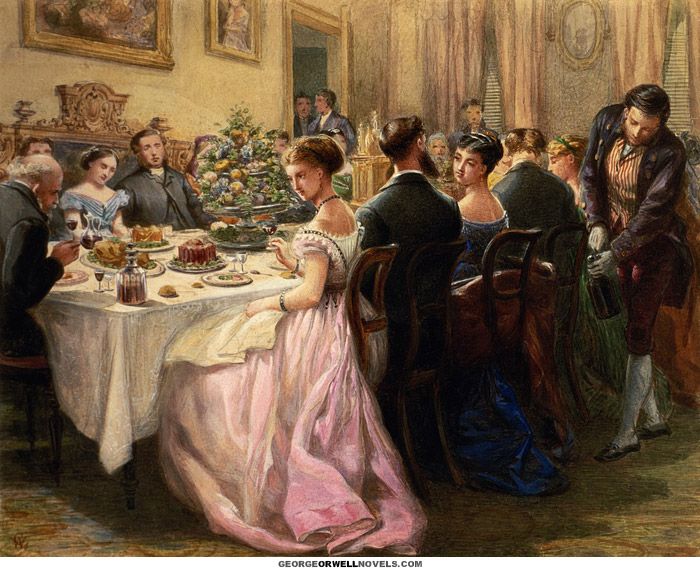
After several dances, you welcome the announcement of supper. In a private ball, the supper dance takes place right before supper, and your partner for that dance escorts you to the dining table and sits next to you. And, naturally, your chaperone remains nearby. Tables are laden with refreshments. Depending on the occasion, you might find cold meats, bread, cakes, pastries, fruit, jellies, and other delicacies. Tea, coffee, wine, punch, and other beverages may be served.
Supper provides another opportunity to socialize. You may find yourself seated near someone you haven’t met before—or perhaps the gentleman who has caught your attention as you danced.
More Dancing, and Perhaps a Little Romance
After supper, the musicians begin again. The candles burn lower but the ballroom remains lively. You return to the dance floor.
Your most intriguing partner returns to ask for a second dance. Now you know he has a special interest in you. This time, the conversation flows more easily. You’ve learned something about one another. You know whether he dances well. You’ve discovered that you share an interest in music or literature or philosophy.
The evening has given you something that a formal introduction alone could not: an opportunity to become acquainted. And that was one of the great social functions of the Regency ball.
When the Evening Comes to an End
Eventually, the musicians play their final set and the candles burn low, marking the end of your delightful evening. The musicians fall silent and your carriage waits outside. You say your goodbyes, collect your belongings, and make your way toward the waiting carriages with your chaperone.
After the warmth of the ballroom, the cool night air refreshes you. As your carriage bears you home through the darkened streets, you replay the evening in your mind and discuss them with your chaperone. Which gentleman asked you to dance? Who paid you particular attention? Did you make a new friend? And will you see that certain gentleman again?
Perhaps you’ll know tomorrow if he calls upon your or sends you flowers. Perhaps you must wait until the next assembly.
Would You Have Enjoyed a Regency Ball?
If you could attend a Regency ball for one evening, what would you look forward to most: the dancing, the beautiful gowns, the music, the food, the possibility of meeting someone special?
I’d love to hear your answer in the comments!
Until next time,
Donna

Hi, Donna! I love the research and care that goes into your posts. I do wonder, where were the musician situated?
I know in châteaus, there were typically lofts for them in the ballroom, but where in a gentleman‘s home in your article?
Hi Elizabeth! It all depended on the house. Some had a loft, some had removable raised platforms, and others simply had the musicians at one end or corner of the room. One of the house I visited had a hidden door next to the platform that lead down narrow stairs to the lower levels that musicians used to come and go. I don’t know how common that was but it made me wonder how they managed to bring anything large like a cello through there.
Getting ready for the ball would be exciting. Choosing the hair style and gown are always fun. However, what really catches my eye are the decorations, The foods served and how it is all displayed. Presentation must be warm and inviting!
That is definitely a highlight for me too! Thanks for stopping by, Raeni !
Wow… I loved your article. It put me right in the middle of a Regency ball. I would have loved to have attended one in the past as all your stories indicate. It takes you right into the reality of your words!
I think I would have enjoyed every aspect of the ball.
Your writing gives me a respite from the sometimes tedious things we do on a day-to-day basis. You are one of my favorites writers. Continue the great work and I look forward to your next story!
Thank you for your kind words, Annelisse! You really made my day!