 From Samhain to Trick-or-Treat,The Surprising History of Halloween
Ghosts, carved turnips, soul cakes, romantic divination, and the curious evolution of All Hallows’ Eve.
What comes to mind when you think of Halloween? Glowing jack-o’-lanterns, kids in costumes, ghost stories, and a bowl of candy by the door that is somehow always half empty before the first trick-or-treater arrives? Here’s a fun twist: many of these traditions have changed quite a bit over the centuries, and some are much newer than you’d guess.
Halloween’s story is a delicious stew of religious observance, folklore, superstition, and community celebration. It stretches from the Gaelic-speaking regions of Europe to medieval England, Regency Scotland, Victorian America, and your neighborhood trick-or-treat route. And the truth is more complicated, and far more interesting, than the popular claim that Halloween is an ancient pagan festival that changed little through the ages.
Samhain: The Season Turns
Our story often begins with Samhain (usually pronounced sowen), a Gaelic festival marking the shift from harvest to winter. It’s generally associated with the beginning of November and held a place in the traditional calendar of Ireland and Scotland.
Imagine the mood. The harvest is in, the days are shrinking, and everyone is stocking up for the cold and hoping the woodpile lasts. It’s no wonder folklore held that these turning points were times when the ordinary world drifted a little closer to the supernatural.
You’ve probably heard Samhain described as the Celtic New Year and a great festival of the dead, when spirits wandered freely among the living. Some Irish stories do link this season with supernatural encounters. However, historians urge a bit of caution, because the evidence doesn’t support every detail of that familiar picture. Ronald Hutton’s scholarly article “The Celtic New Year and Feast of the Dead” explores how these ideas developed, and it’s a handy reminder that popular accounts sometimes toss evidence from different eras into the same cauldron.
I’ll confess this was a surprise to me: there’s no evidence that our modern Halloween customs sprang from this one festival. Samhain belongs in the story, but it’s one character in a large cast.
All Hallows’ Eve: A Christian Calendar Takes Shape
Halloween’s name comes from All Saints’ Day, also called All Hallows’ Day. Hallow means holy, and All Hallows’ Eve was simply the evening before. Say it often enough, and it shortens to Halloween. Language is lazy that way.
All Saints’ Day honors the saints, while All Souls’ Day, observed on November 2 in the Western Christian calendar, traditionally focused on prayers for the dead. Together with the eve of All Saints’, these observances formed a season known as Allhallowtide.
Samhain and All Hallows’ Eve land at roughly the same seasonal turning point, which makes it tempting to say the Church just slapped a new name on the old festival. But we don’t actually know that, and the relationship between older seasonal customs and Christian observances is far more tangled. What we do know is that late October and early November became tied to both religious remembrance and a rich tradition of folklore about death, spirits, and the thin line between this world and the next.
Soul Cakes and the Tradition of Giving
Another surprising fact about the history of Halloween has become one of my favorite Allhallowtide customs: souling. In medieval England, people went door to door asking for food or charity, and in return they offered prayers for the householders’ departed relatives. The traditional payment was a soul cake, a small cake made with things like oats, spices, and dried fruit. Not a bad trade, honestly.
English Heritage notes that soul cakes are recorded around 1400, though the custom was apparently older. It carried on in some places for centuries, even as religious attitudes shifted.
Many people believe souling is the direct ancestor of trick-or-treating, and the resemblance is hard to miss: folks visit homes, ask for a snack, and take part in a seasonal tradition. But Halloween customs developed differently from region to region, and the modern practice didn’t come down in one neat, unbroken line.
Halloween in the Georgian and Regency Eras
If you’re a fan of the Georgian and Regency periods like I am, Halloween offers a delightful peek at the private amusements and superstitions of the past.
In Scotland, Robert Burns documented Halloween customs in his 1785 poem Halloween, and his notes explain many of the evening’s charms and rituals, especially the ones meant to predict the future. Picture a group of young people watching nuts roast in the fire and reading their movements as signs of affection or rejection. (Two nuts sizzling quietly together? Promising. One popping off dramatically? Awkward.) Or imagine someone peeling an apple in one long strip and tossing it over her shoulder, hoping it lands in the shape of her future sweetheart’s initial. These customs were a fine excuse for laughter, flirtation, and a little matchmaking, even among people who didn’t take the results entirely seriously.
Burns’s poem is especially valuable because it preserves descriptions of rural Scottish customs of his time. Traditions varied by region, though, so don’t assume every fashionable household in Regency London was out there tossing apple peels. They may well have had their own games and omens.
 Why Turnips Came Before Pumpkins
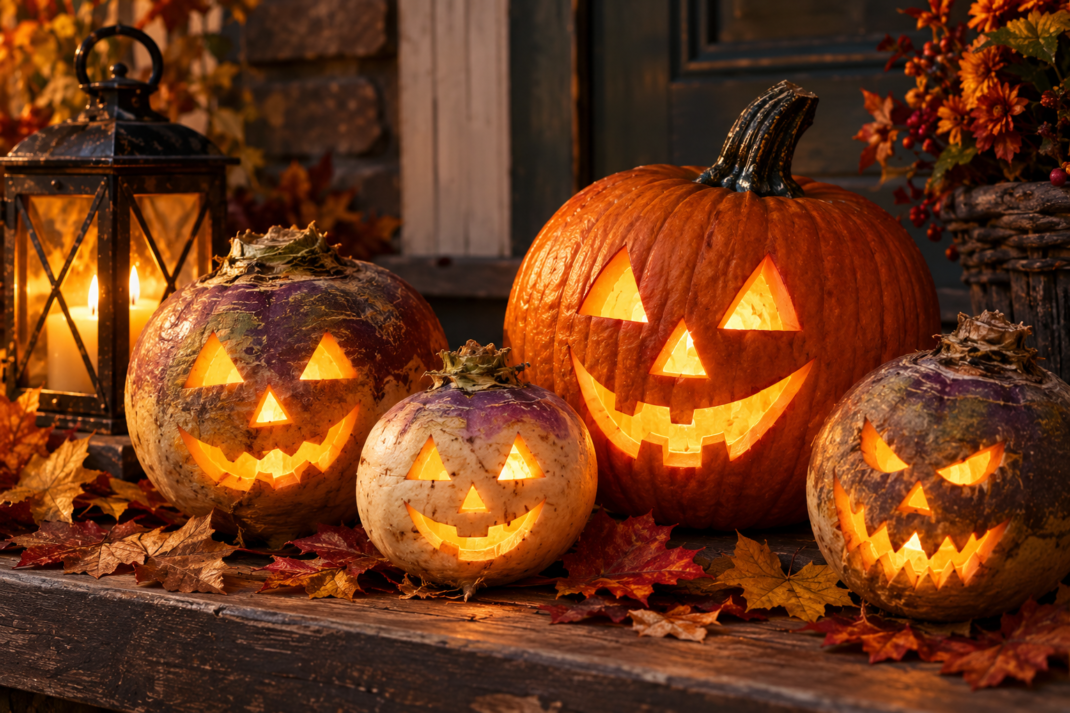
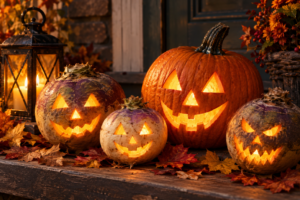
Today the carved pumpkin is practically Halloween’s mascot, but it wasn’t the traditional lantern of Britain and Ireland. There, people carved faces into root vegetables like turnips or swedes (rutabaga) and lit them from within. Imagine hollowing out a turnip. Your forearms have my sympathy. I’d probably cut off one of my fingers which is why I prefer the painted variety.
Anyway, folklore linked to jack-o’-lanterns features Stingy Jack, a man who repeatedly outwitted the Devil. After his death, the legend goes, Jack was condemned to wander with a burning coal to light his way. Carved vegetable lanterns became associated with the tale, and with Halloween.
When Irish immigrants brought their customs to North America, they found pumpkins plentiful and much easier to hollow out than root vegetables. Pumpkins gradually became the American favorite, which means this seemingly ancient, universal symbol is, in its familiar form, a relatively recent development.
(For more on this transformation, see my related article, Halloween Pumpkins and…Turnips?)
Victorian Halloween: Folklore, Fortune-Telling, and Fun
The Victorians adored folklore, ghost stories, and all things supernatural, so naturally they got busy recording, discussing, and reshaping Halloween customs. Older practices involving love and marriage carried on, with young people trying rituals meant to reveal a future spouse, and ghost stories becoming wildly popular entertainment.
All that enthusiasm for collecting folklore had a lovely side effect: it preserved customs that might otherwise have vanished. Writers and observers jotted down local beliefs, games, rhymes, and stories, giving later generations a glimpse of how people marked the season.
Halloween was never just one thing. It could be religious, mischievous, romantic, frightening, or all of the above at once, sometimes before dinner.
 Halloween Crosses the Atlantic
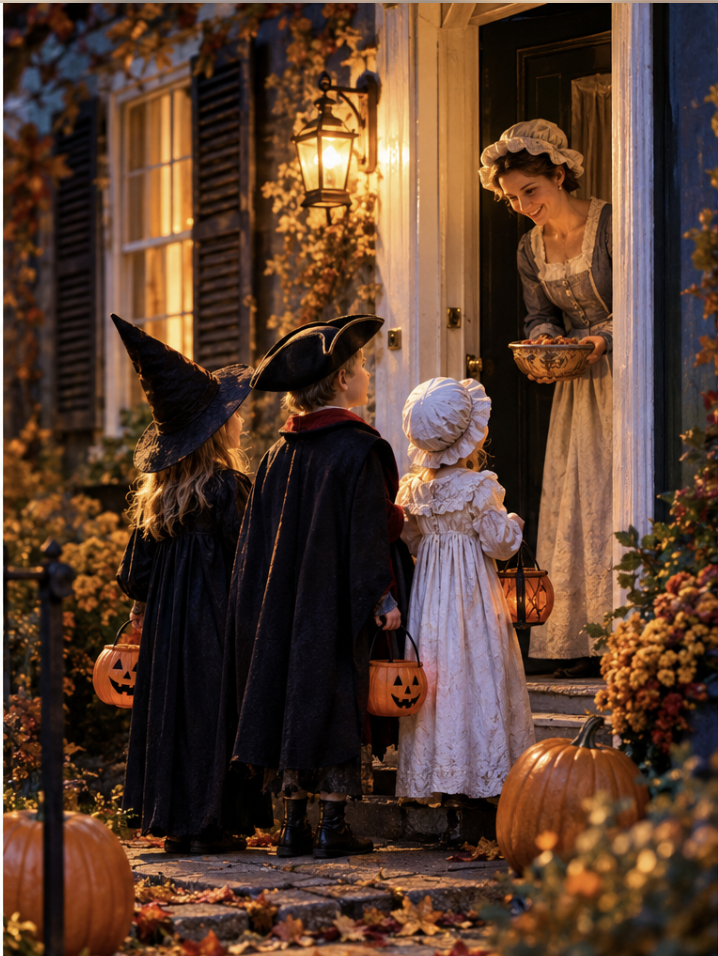
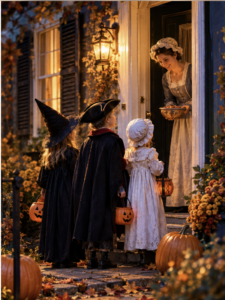
As I mentioned, immigrants from Ireland and Scotland carried Halloween traditions to North America, where they mingled with local customs and took on new forms.
During the nineteenth century, in parts of the United States, Halloween was not the child-friendly celebration we know today. Picture a night of pranks: gates moved, neighbors tricked, and frightening surprises lurking in the dark. Carved pumpkins, costumes, parties, games, and fortune-telling gradually joined the mix, and by the early twentieth century, communities steered all that mischief into organized activities that were safer and more fun for kids. (Adults everywhere sighed with relief.)
The phrase trick-or-treat began appearing in the twentieth century, and the practice became widespread in the decades after World War II. As suburbs grew and individually wrapped candy made handing out treats easy, door-to-door trick-or-treating became a beloved part of American childhood.
Today, Halloween blends seasonal celebration, religious history, folklore, immigration, popular entertainment, and a healthy dose of commerce. Costumes and candy rule in many communities, while others prefer haunted attractions, pumpkin carving, harvest festivals, or a quiet evening with a good ghost story.
A Holiday That Keeps Changing
Traditions are rarely set in stone. They travel, adapt, and pick up new meanings as people carry them to new places and generations.
That candy-filled bucket and glowing pumpkin on your porch connect to medieval prayers for the dead, Scottish love divination, carved turnip lanterns, Victorian folklore, and American neighborhood celebrations. No single custom explains the whole holiday, and not every popular story about its origins holds up as fact.
Maybe that’s part of Halloween’s charm. It leaves room for mystery, imagination, laughter, and a little harmless fear, and it invites us to remember the past while making traditions of our own.
So the next time you see a jack-o’-lantern glowing on a doorstep this October, remember that its story is much longer, and much more surprising, than its toothy grin suggests.
Happy Halloween, and happy reading!
—Donna Hatch
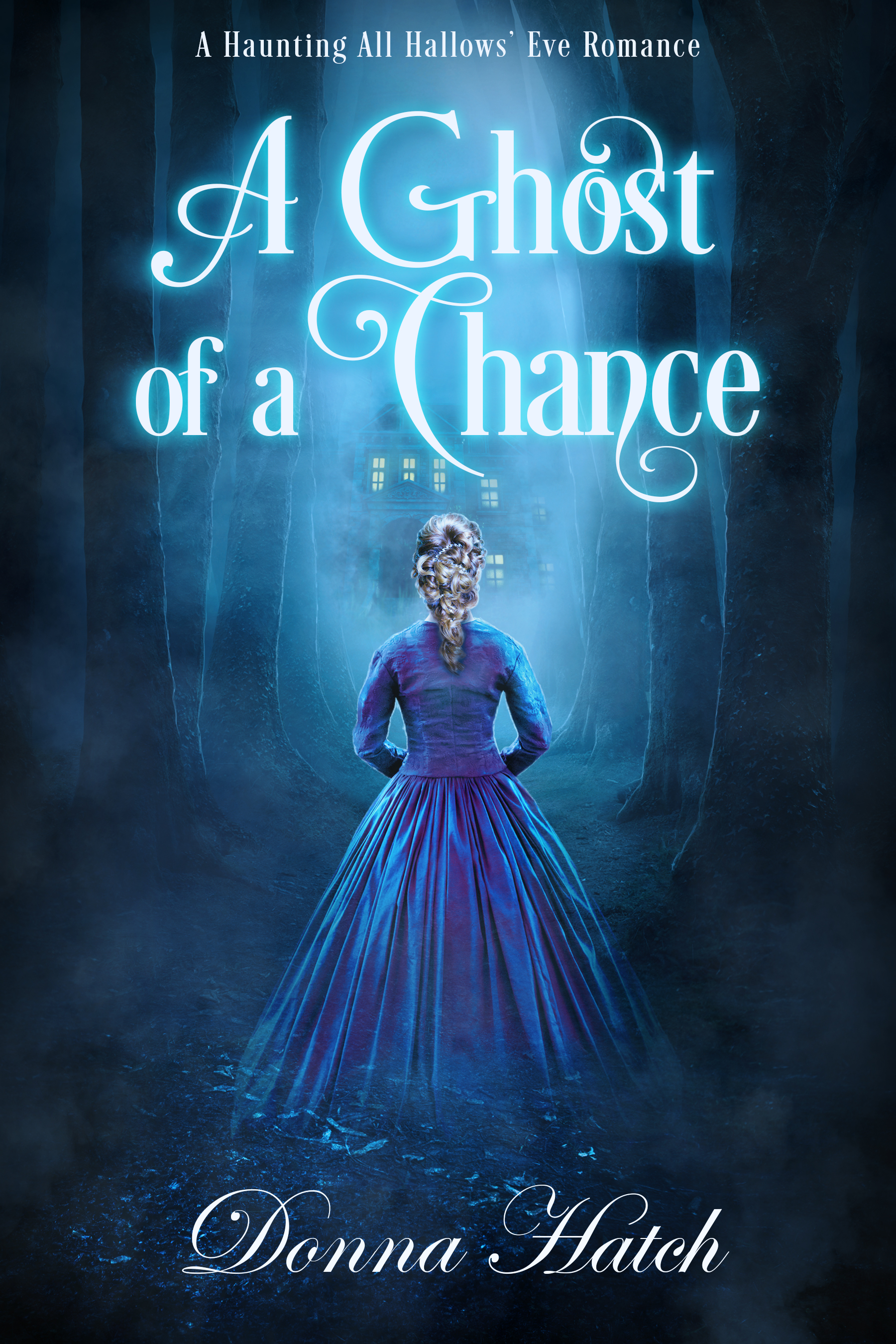 P.S. If all this talk of ghosts and All Hallows’ Eve has you in the mood for a spooky-sweet read, you might enjoy my Regency paranormal romance, A Ghost of a Chance: A Haunting All Hallows’ Eve Romance.
Fun fact: the first few chapters came to me in a dream, and I had to figure out the rest on my own. (Dreams are generous that way, but they don’t finish the job.)
It’s a tale of love, second chances, and a very ghostly detour to beg the Angel of Death for more time. If it sounds like your cup of tea, I’d be delighted if you gave it a look.
It’s available from your favorite book retailer at this Universal book link (UBL)
Further reading
- Halloween and All Hallow’s Eve Traditions
- Halloween Pumpkins and…Turnips?
- Ghosts, Superstitions, and Regency Halloween Traditions
